
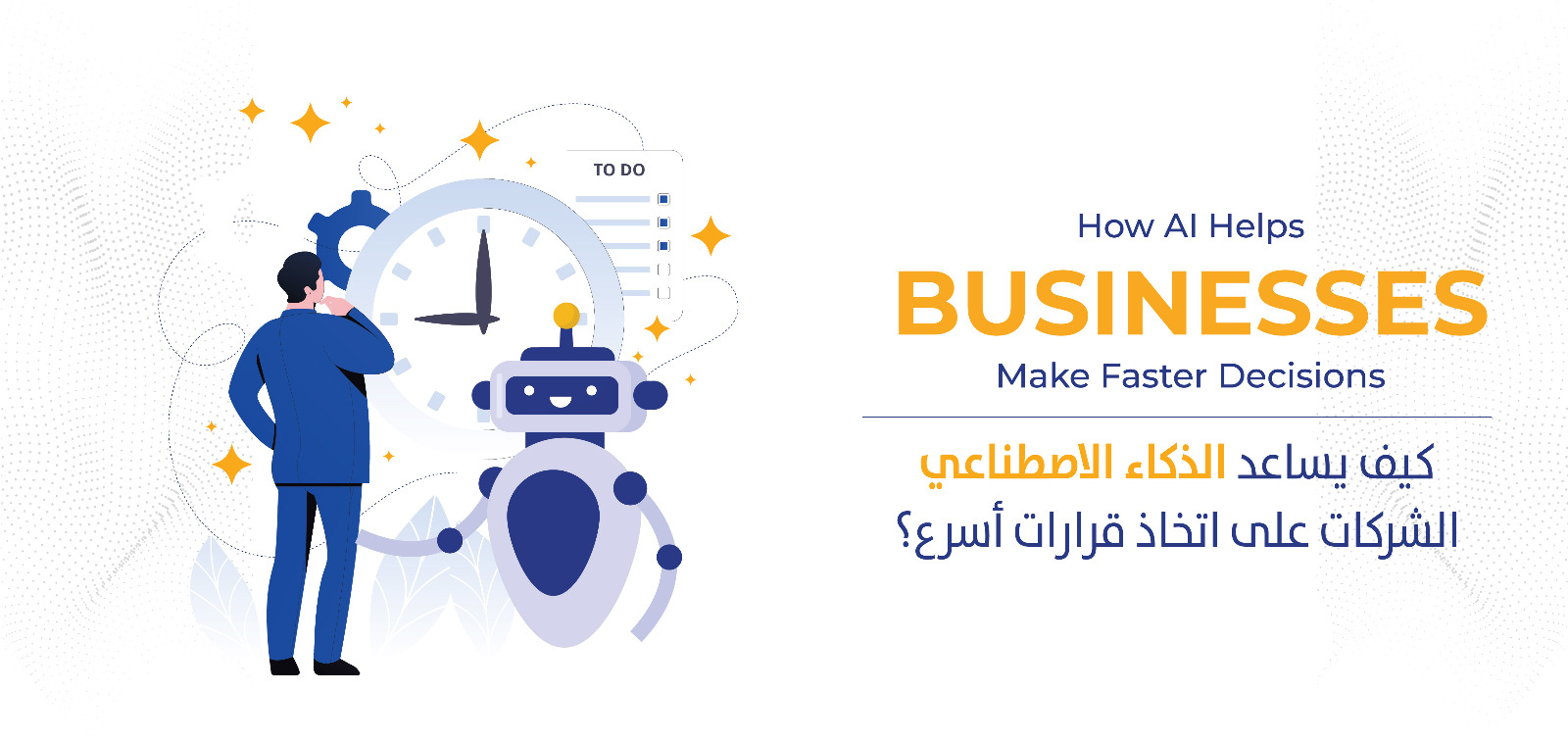
Walk into almost any executive meeting today, and you'll notice something interesting. The biggest challenge isn't always fierce competition or declining sales. More often than not, it's time. By the time leadership teams finish reviewing last month's reports, customer behavior has already shifted, market conditions have changed, and valuable opportunities may have disappeared. For many organizations, the real issue isn't a lack of information—it's the delay between recognizing what's happening and deciding what to do about it. This is exactly where artificial intelligence is beginning to transform the way businesses operate.
Artificial intelligence isn't replacing business leaders or making strategic decisions on their behalf. Instead, it's helping them make better decisions much faster by turning scattered information into meaningful insights while there's still time to act. The goal isn't to remove human judgment from the process but to strengthen it with faster access to reliable information.
Businesses today generate more data than ever before. Sales figures are stored in CRM systems, financial information lives in accounting software, and customer interactions happen across emails and support platforms, while marketing performance is spread between analytics dashboards and spreadsheets. Every system holds part of the story, yet very few organizations have a complete picture at any given moment. As a result, managers often spend days collecting reports, comparing numbers, and trying to understand what they actually mean. By the time they finally reach a conclusion, the business environment has already moved on.
Artificial intelligence dramatically shortens this process. Instead of asking employees to manually gather and analyze reports from multiple systems, AI can process information from different business platforms simultaneously, identify meaningful patterns, detect unusual changes, and present actionable insights within seconds. What once required weeks of manual analysis can now be viewed through a single dashboard that updates continuously as new information becomes available. The real advantage isn't simply faster reporting—it's ensuring decision-makers receive the right information while it's still relevant.
One of the biggest misconceptions about artificial intelligence is that making faster decisions means making rushed decisions. In reality, the opposite is often true. AI reduces the time spent searching for answers, giving leaders more time to evaluate possible actions instead of collecting data. More importantly, decisions supported by objective analysis are often stronger than those based primarily on instinct or personal assumptions. Experience will always matter, but even the most experienced executives can overlook patterns or become influenced by unconscious bias. AI offers another perspective by highlighting trends that might otherwise go unnoticed and supporting discussions with evidence rather than assumptions. Just as doctors rely on medical imaging before surgery to improve diagnosis, modern businesses increasingly rely on predictive analytics before making high-impact decisions.
Consider a retail company operating stores across several regions. Every week, managers need to determine how much inventory should be allocated to each location. Traditionally, those decisions rely on historical sales figures, seasonal expectations, and managerial experience. While these remain valuable sources of information, they don't always provide the complete picture. An AI-powered system can simultaneously analyze historical sales, customer purchasing behavior, regional demand, promotional campaigns, inventory turnover, stock shortages, and daily buying patterns. Instead of discovering shortages after customers leave empty-handed or realizing warehouses are overstocked after the season ends, managers receive early warnings that allow them to adjust inventory before problems occur.
This doesn't mean artificial intelligence can predict the future with perfect accuracy. Markets remain unpredictable, consumer behavior changes constantly, and external events will always introduce uncertainty. What AI provides is something far more practical: early visibility into possible outcomes. Having several realistic scenarios gives management teams more time to prepare, reduce risks, and respond proactively before minor issues grow into expensive business problems.
At the same time, purchasing software labeled "AI-powered" isn't enough to transform an organization. Technology can accelerate effective processes, but it cannot repair broken decision-making structures on its own. If responsibilities are unclear, approval processes are inefficient, or managers don't know which business metrics deserve the most attention, artificial intelligence simply produces more reports without delivering meaningful business value. Successful implementation begins by identifying where decisions repeatedly slow down. Which approvals consistently delay projects? Where do managers spend unnecessary hours waiting for information? Which recurring decisions consume excessive management time? And what problems are usually discovered only after it's too late to respond effectively? Once these bottlenecks are identified, AI can be introduced in targeted areas where its impact can be measured clearly.
Data quality also plays a critical role in determining whether artificial intelligence succeeds or fails. Even the most advanced algorithms cannot compensate for incomplete, outdated, duplicated, or inaccurate information. If the data feeding an AI system is unreliable, the recommendations it generates will be equally unreliable. For this reason, organizations should stop viewing data management as a purely technical responsibility. Clean, accurate, and well-maintained data forms the foundation of every intelligent business decision.
Transparency is equally important. Decision-makers should never receive recommendations without understanding how those recommendations were generated. The most effective AI systems explain the reasoning behind their conclusions, allowing managers to evaluate the evidence rather than blindly accepting automated suggestions. This becomes especially important when decisions involve customers, employees, investments, financial planning, or operational risk. Trust in AI grows when people understand not only what the system recommends, but also why it recommends it.
Although artificial intelligence excels at processing enormous amounts of information, identifying hidden patterns, and continuously monitoring business activity, people remain far better at understanding context, interpreting ambiguity, weighing ethical considerations, and recognizing factors that cannot easily be translated into numbers. The strongest organizations don't choose between artificial intelligence and human expertise—they combine them. Technology contributes speed, consistency, and analytical depth, while experienced leaders contribute judgment, creativity, and strategic thinking. Together, they produce decisions that are both faster and significantly better.
Perhaps the most exciting aspect of this transformation is that it is no longer limited to large enterprises with massive technology budgets. Cloud-based AI platforms have made intelligent decision-support tools accessible to small and medium-sized businesses as well. Companies of every size now have the opportunity to strengthen their decision-making capabilities without investing in enormous infrastructure. As a result, the competitive advantage no longer belongs exclusively to organizations with the biggest budgets—it belongs to those willing to adopt smarter ways of working earlier than everyone else.
The companies that succeed over the coming years won't necessarily be the ones that collect the most data. They'll be the ones that can transform information into confident, timely decisions before their competitors do. In today's business environment, making faster decisions is no longer just a competitive advantage—it's becoming a fundamental requirement for long-term success. Before investing in another reporting tool or dashboard, organizations should ask a much simpler question: Are our decisions based on yesterday's reports or today's reality? The answer to that question may determine how well they compete in the years ahead.