
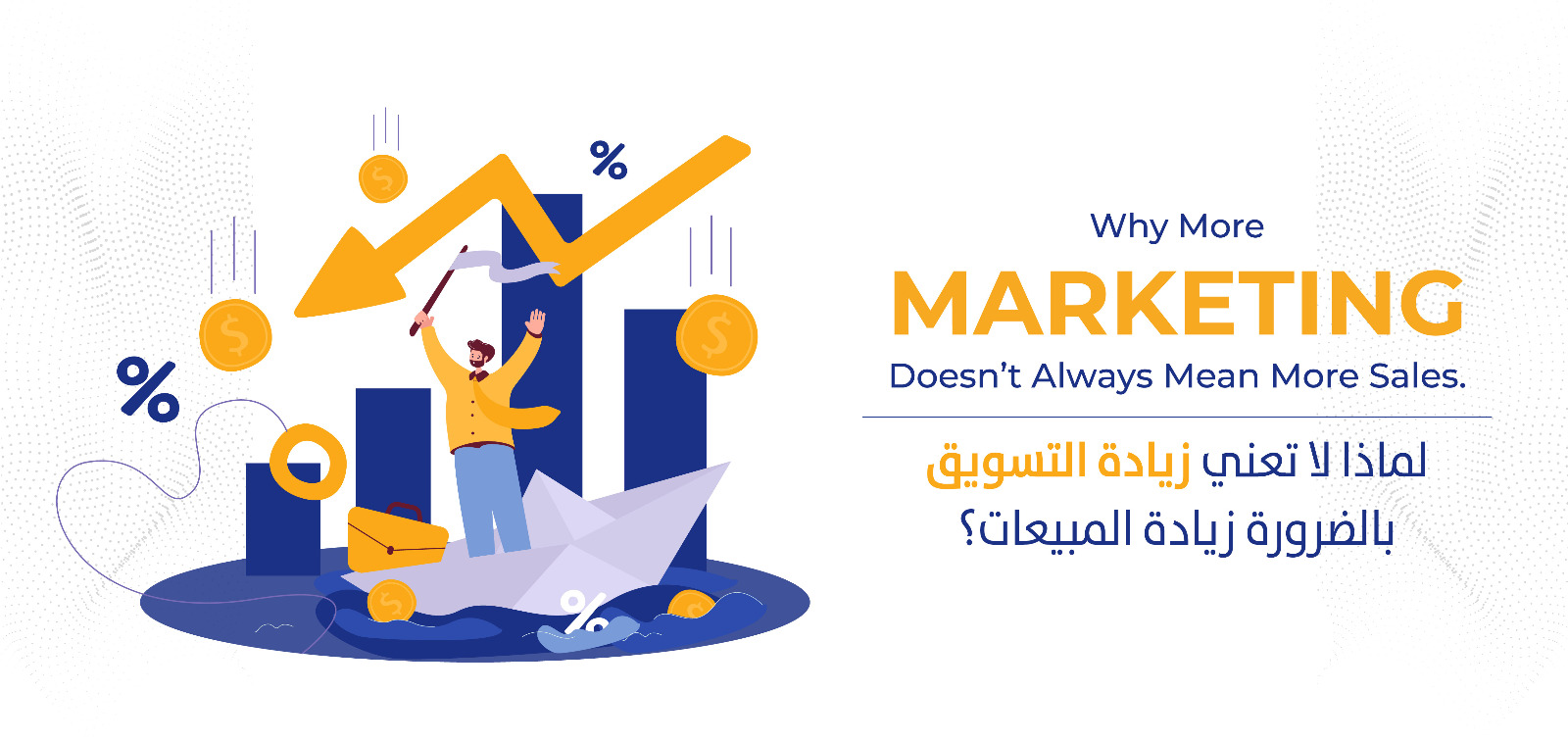
Most businesses scale marketing for the right reason—growth—but with the wrong assumption: that more spend automatically creates more revenue. The logic feels clean. A modest budget brings a modest number of leads, so doubling that budget should double sales. In reality, increased spend usually increases volume first, not conversion. That’s why many teams see a familiar pattern: leads go up, dashboards look healthier, and revenue barely moves.
Marketing is not a substitute for a sales system. It is a stress test for it. If the path from lead to closed deal is unclear, slow, inconsistent, or poorly tracked, more marketing does not fix the problem—it exposes it faster and at a higher cost.
When Marketing Becomes Noise
Marketing becomes noise when it optimizes for reach instead of relevance. When a brand tries to speak broadly, it rarely persuades deeply. You may be “present everywhere,” but presence alone is not persuasion. Real growth happens when a specific promise reaches a defined buyer who recognizes their own problem immediately—at a moment when they are already searching for an answer. Without that alignment, bigger budgets buy activity: clicks, form fills, engagement, and casual inquiries. Those metrics can look impressive while intent remains low and conversion remains unstable.
The Bridge to Nowhere: A Broken Ecosystem
Even when the message is right, the second bottleneck is operational. Leads arrive, but the organization is not built to capture them consistently. Response time varies from one rep to another. Follow-up depends on memory, not process. Qualification is vague, so serious opportunities receive the same attention as low-intent conversations. The handoff between marketing and sales is blurry, so nobody can confidently say which sources generate revenue and which sources generate noise. In that environment, scaling marketing increases workload faster than it increases sales. The team feels busier, but the business does not get meaningfully richer.
This is where friction quietly destroys momentum. A prospect lands on a page that is unclear, slow, or missing the information needed to make a decision. They submit a request and wait too long for a response. They get contacted, but the next step is not defined, so the conversation stalls. They compare you to a competitor who responds faster, communicates more clearly, and makes the journey easier. None of this feels dramatic, but it is decisive. Small frictions compound into lost deals, and more traffic through a leaky process increases drop-off more than it increases profit.
Trust cannot be forced
Then there is the part that dashboards rarely capture: trust. Modern buyers are not impressed by volume. They can sense when a brand is pushing for attention through repetition rather than earning attention through value. When a company floods the market with low-quality touchpoints, it risks damaging credibility—the asset that actually closes deals. Sales are not built on visibility alone. They are built when customers feel that a brand understands their need with precision, communicates with clarity, and delivers a consistent standard across the entire experience. Trust is earned when the brand provides genuine value before asking for commitment, not when it simply increases frequency.
This is why scaling marketing should rarely be the first move. It can be a powerful catalyst, but only after conversion is stable. If the internal system is not ready—speed to lead, qualification, follow-up discipline, pipeline visibility, and measurement—expansion will amplify weaknesses rather than produce growth. The smarter sequence is to strengthen the conversion foundation first, then scale spend with confidence. When the journey is smooth, the process is consistent, and the data is clean, marketing stops being an expensive bet and becomes a predictable lever.
In the end, the goal is not to market more. The goal is to market with precision—and to ensure the business can convert demand into revenue with consistency and control. When that foundation is in place, even a modest marketing effort can generate strong sales results, because it is no longer fighting against your own process.